
For Immediate Release: Friday, March 13, 2026
FY27 Recommend Budget Fully Funds MCPS Requested Budget
6.3 Cent Property Tax Increase and 0.01% Income Tax Increase Proposed to Fund MCPS Request and Maintain County Government Services
Montgomery County Executive Marc Elrich today released his recommended Fiscal Year 2027 (FY27) Operating Budget. The proposal continues investments in public education, affordable housing, public safety, health and human services, transportation, climate action, and economic opportunity while maintaining the County’s long-term fiscal stability amid growing economic uncertainty.
For more information on the FY27 Recommended Operating Budget, visit the Office of Management and Budget website. A video of the County Executive’s presentation is available on the County’s YouTube page.
The proposed budget reflects rising costs in housing, health care and other household necessities, continued pressure on County services, and reductions in certain federal funding streams that support local programs and nonprofit partners.
“This budget reflects a simple reality: Montgomery County continues to face growing needs at a time of economic uncertainty, rising costs, and increasing pressure on the services residents depend on every day,” said County Executive Elrich. “In this environment, budgets require discipline and clear priorities. My FY27 Recommended Operating Budget protects the services residents rely on most while maintaining Montgomery County’s long-term fiscal stability. It continues our investments in strong public schools, support for families, affordable housing, public safety, climate action, and a government that works effectively and responsibly for all residents.”
The County Charter requires the County Executive to submit a recommended budget to the County Council by March 15 each year. The Council will review the proposal over the coming months before adopting a final budget in May. The new budget will take effect on July 1.
Key Highlights of the FY27 Recommended Budget
- Fully funds the Montgomery County Public Schools operating budget request with $3.8 billion in total operating funding.
- Includes the full request from the Board of Education for MCPS: $189.9 million increase over FY26.
- Exceeds the State’s Maintenance of Effort requirement for MCPS by more than $202.8 million.
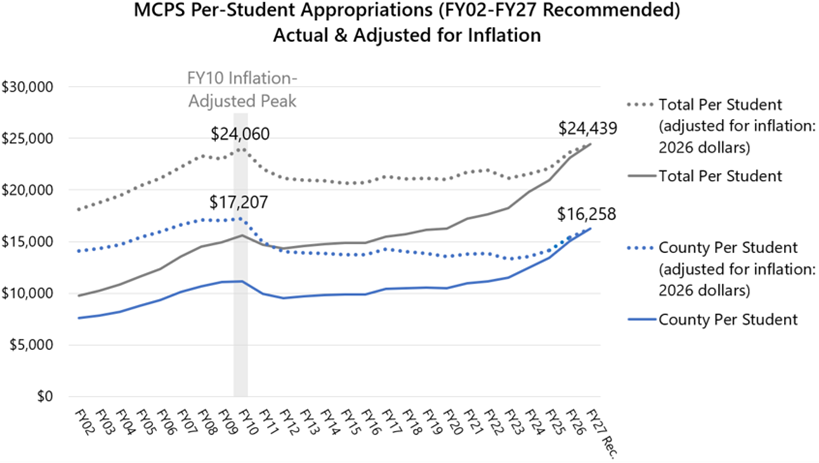
- Continues progress toward restoring per-pupil funding toward its inflation-adjusted peak from FY10.
- Includes $152.7 million in investments for affordable housing, rental assistance, and neighborhood revitalization.
- Strengthens health and human services, including health care access, food assistance, crisis response, and homelessness prevention.
- Funds almost 1400 full-time fire and rescue staff and 1,850 full-time positions in the police department as well as technology expansion and system modernization.
- Continues Zero Fare Ride On, roadway resurfacing, and pedestrian safety initiatives: expansion of Flash Bus Rapid Transit and Ride On FLEX and civilian parking enforcement to reduce police workload.
- Expands climate and environmental investments, including $19.4 million for the Montgomery County Green Bank.
- Includes targeted investments in economic and workforce development, including the Institute for Health Computing, HJF Innovation Labs, and Bio Hub Maryland, a state-of-the-art training center to help individuals pursue careers in life sciences.
- Includes targeted reductions and efficiency measures instead of broad service cuts.
Balancing the Budget
To sustain essential services and respond to rising costs, the FY27 recommended budget includes both targeted revenue enhancements and expenditure reductions.
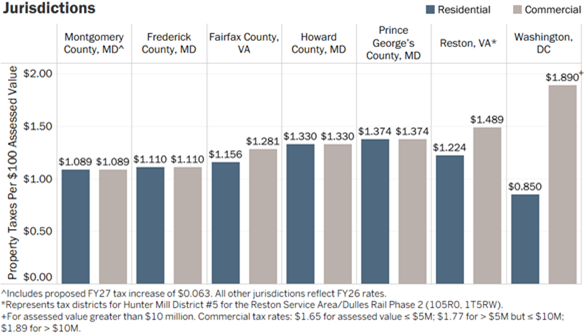
The proposal includes a 6.3-cent property tax increase dedicated to Montgomery County Public Schools. Even with this adjustment, Montgomery County would continue to maintain one of the lowest residential property tax rates in the region as illustrated in the chart below.
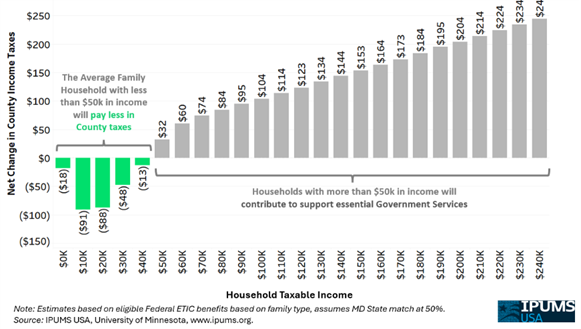
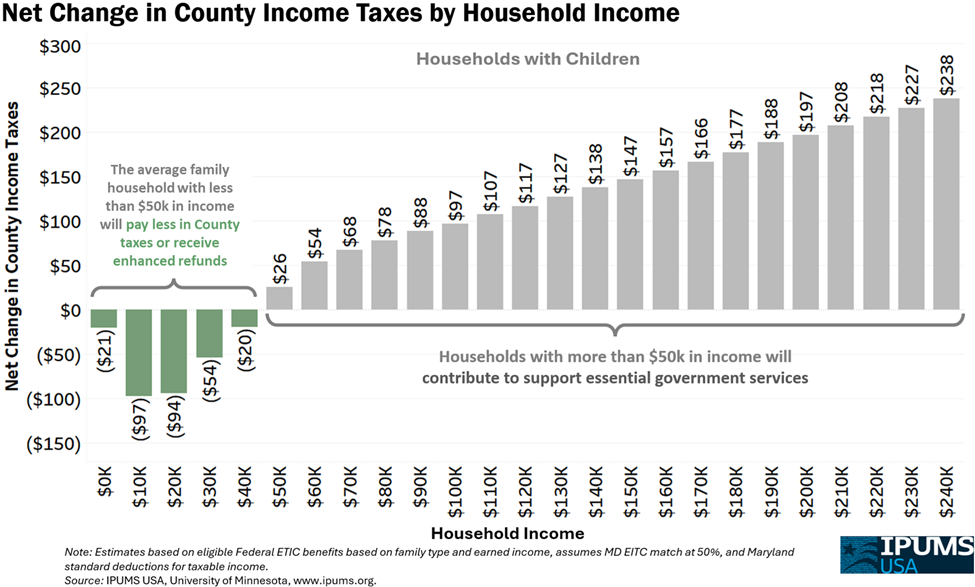
The budget also includes a modest and progressive income tax adjustment, increasing the County’s income tax rate from 3.2% to 3.3%. That 0.1 percentage point adjustment equals about $100 annually for a household with $100,000 in taxable income. To offset the impact on lower-income residents, the budget also proposes increasing the County’s Working Families Income Supplement match from 56% to 60% of the State Earned Income Tax Credit amount, helping households earning less than $50,000.
The budget also includes $18.96 million in expenditure reductions and additional vacancy savings to help maintain balance while minimizing service disruptions.
“Budgets ultimately reflect priorities,” said County Executive Elrich. “I cannot fund every worthy request, but I will always prioritize the investments that strengthen our County for the long term—supporting our students and educators, stabilizing families, expanding housing opportunity, protecting public safety, addressing the climate emergency, and ensuring that County government delivers results efficiently and equitably.”
Strengthening MCPS and Investing in Children and Families
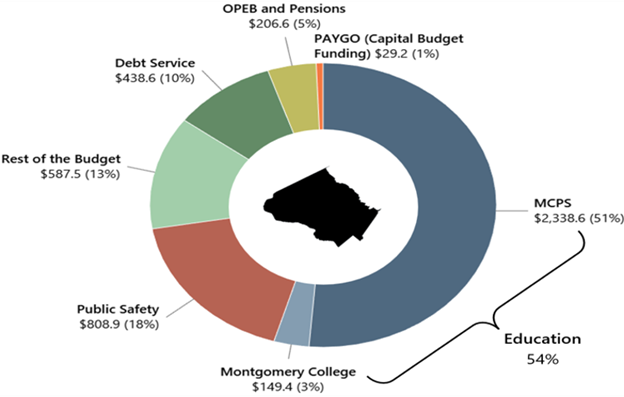
The FY27 recommended budget provides $3.8 billion in operating funds for Montgomery County Public Schools (MCPS), an increase of $189.9 million over the prior year and more than half of the County’s total tax-supported budget. The County contribution increases by $179.6 million.
The recommendation fully funds the Board of Education’s request and continues Montgomery County’s recent pattern of historic levels of investment in our schools. If approved by the County Council, the four largest increases in County funding for MCPS will have occurred over the last four fiscal years.
“Montgomery County Public Schools remain one of the most important investments we make as a community,” said County Executive Elrich. “Strong schools support working families, strengthen neighborhoods, and help sustain Montgomery County’s long-term economic vitality.”
The budget for MCPS includes:
- Full funding of the negotiated compensation agreements for teachers and MCPS staff.
- Additional support for special education.
- Continued support for mental health, and Blueprint for Maryland’s Future implementation
- Funds 28 security officers at elementary schools.
- A funding level that exceeds the State’s Maintenance of Effort requirement by more than $202.8 million.
- Continued progress toward restoring per-pupil funding toward its inflation-adjusted FY10 peak.
“Montgomery County Public Schools thanks the County Executive for his budget recommendation, which significantly increases operational funding for our school system and recognizes the essential needs of our students and staff. MCPS’ proposed budget focuses on the fundamentals—academic excellence, student well-being, and long-term financial sustainability,” said Montgomery County Public Schools Superintendent Thomas W. Taylor, Ed.D., M.B.A. “These investments are vital to ensuring every student has the tools to succeed in a modern learning environment. We remain committed to full transparency and will continue working closely with county officials to demonstrate the direct impact of these funds in our classrooms and school communities.”

“Once again, County Executive Elrich has demonstrated real leadership and a deep commitment to students, educators, and strong public schools; it is easy to make these commitments when times are good, it takes real courage in tough times like these,” said Montgomery County Educators Association President David Stein. “This budget makes critical investments in educator recruitment and retention, special education, and school safety. The County Council needs to follow the County Executive’s leadership and fully fund this budget.”
“The thousands of support staff represented by SEIU Local 500 are the backbone of Montgomery County Public Schools. Every day they keep our schools running and ensure students have the support and environment they need to succeed,” said SEIU Local 500 President Pia Morrison. “We are grateful to County Executive Marc Elrich for recognizing their importance by putting forward a budget that not only fully funds MCPS today but also advances thoughtful proposals to ensure stable funding for the future. That is the kind of leadership our students, families, and school staff deserve. We urge the County Council to stand with our school communities, support this proposal, and fully fund this budget.”
The recommended budget also continues Montgomery County’s commitment to early care and education with a 4% increase to the Early Care and Education Non-Departmental Account, including $500,000 to move children from the State child care scholarship waitlist into the County’s Working Parents Assistance Program helping ensure that more families have access to reliable and affordable child care.
Since the launch of the Early Care and Education Initiative in 2019, Montgomery County has:
- Invested more than $71 million in early care and education initiatives.
- Created more than 1,265 child care seats.
- Supported more than 450 current and future early childhood educators through a Montgomery College credentialing pipeline.
“Access to high-quality child care is one of the most important determinants of a child’s academic success. It is also essential to Montgomery County’s economic health,” said County Executive Elrich. “Reliable early care allows parents to participate fully in the workforce while ensuring that young children enter school ready to succeed. Early childhood programs are not simply family services—they are core economic infrastructure.”
Strengthening Health and Human Services
The FY27 budget continues Montgomery County’s investments in health care access, behavioral health, food security, prevention of homelessness, and programs addressing longstanding health disparities.
Key investments include:
- Backfilling loss of state and federal funding.
- Tuberculosis diagnosis, treatment, and mitigation.
- Emergency preparedness and response.
- Improving reimbursement rate for Montgomery Cares providers from below half to 52%, supporting 25,000 uninsured or uninsurable individuals.
- Five percent increase for Adult Medical Day Care Supplement and Developmental Disability Supplement.
- Improving one-stop access to County services by expanding the Community Connect Portal.
- Continues Head Start contractual nurse staffing.
- Increased funding for the Senior Nutrition program to account for increased food costs.
- Increased support for the Dental Program, including $976,000 for hourly rate increases and $75,000 for replacement equipment.
- Support for eight Mobile Crisis Outreach Teams, the largest behavioral health mobile crisis deployment in County history.
- More than $19 million in FY27 funding for the Latino Health Initiative, African American Health Program and Asian American Health Initiative, compared with approximately $5.1 million in FY20.
- More than $12 million annually in food assistance through the Office of Food Systems Resilience.
- Growth in Services to End and Prevent Homelessness from $24.5 million in FY20 to more than $68 million in the FY27 recommended budget.
- $2 million for the Short-Term Housing and Resolution Program (SHaRP).
- $2 million for overflow emergency shelter support,
- $1.2 million support for adult shelter,
- $439,000 to connect services to unsheltered residents,
“The pandemic exposed deep health disparities that have existed in our community for decades,” said County Executive Elrich. “Those disparities reinforced the importance of sustained investment in public health infrastructure, community-based health services, and programs that address the underlying social determinants of health. This budget continues that work and helps prevent disruptions to services residents rely on every day.”
Expanding Affordable Housing and Strengthening Neighborhoods
The FY27 recommended budget includes $152.7 million to expand the preservation and production of affordable housing
Major housing investments include:
- $52.3 million for the Housing Initiative Fund.
- Including $28.4 million for Rental Assistance.
- $9.7 million for Housing First (Health and Human Services),
- $14.2 million across various programs: Housing Production and Preservation, Homeowner Downpayment Assistance and Neighborhood Revitalization, and more,
- $100.4 million in the FY27 Capital Improvements Program for affordable housing acquisition and preservation.
- $96.1 million for Affordable Housing Acquisition and Preservation.
- $4.3 million across various initiatives including Affordable Housing Opportunity Fund, Nonprofit Preservation Fund, and Revitalization for Troubled and Distressed Common Ownership Communities.
- $64 million in new funding for preservation and production from taxable bonds in the CIP.
Since FY19, Montgomery County has financed 9,200 affordable rental units across 114 projects and delivered 2,205 Moderately Priced Dwelling Units, including 1,604 rental units and 601 homeownership units.
Since FY20, the Office of Landlord-Tenant Affairs has responded to more than 50,000 service requests, investigated more than 6,000 complaints, and helped prevent homelessness for more than 1,850 households. The newly created Office of Rent Stabilization has handled 1,390 cases and negotiated an average 56% reduction in proposed rent increases.
Advertisement
“Our affordable housing strategy prioritizes the development of new units, the preservation of existing affordable housing, tenant protection, and pathways to home ownership,” said County Executive Elrich. “These investments are designed for indivduals on fixed incomes, working families, and first-time homebuyers, enabling them to continue residing and prospering in this community.”
Investing in Public Safety and Emergency Preparedness
The FY27 recommended budget continues investments in law enforcement, emergency response, reducing recidivism and climate resilience.
For the Montgomery County Department of Police, the budget includes:
- Adding drones to the Drone as First Responder program and switching to a more efficient remote-operated drone system.
- New case management software to improve investigative efficiency,
- Continued implementation of the Speed on Green initiative and a revamped speed and red-light camera program,
For Montgomery County Fire and Rescue Service, the budget includes:
- Conversion of an existing daytime EMS transport unit to 24-hour operation without adding new positions,
- Continued support for EMS system improvements and mobile integrated health services,
For the Office of Emergency Management and Homeland Security, the recommended budget:
- Replaces reduced federal support with County funds for critical emergency response programs.
- Everbridge, which powers Alert Montgomery, the County’s emergency notification system.
- Specialized equipment, including communications tools and emergency response gear for operational readiness.
- Replacing Public Access Trauma Care kits nearing expiration dates.
- Continues the Non-Profit Security Grant Program.
For the Department of Correction and Rehabilitation, the recommended budget:
- Establishes dedicated K9 unit to detect contraband and facilitate security.
- Continues important rehabilitation programs.
- “Sweet Release” Bakery program.
- Full-time Instructors for educational and training programs.
“Montgomery County remains one of the safest large jurisdictions in the nation,” said County Executive Elrich. “This budget continues investments that strengthen law enforcement, emergency response, disaster preparedness, and rehabilitation services while supporting the dedicated public servants who keep our community safe.”
Transportation and Mobility
The FY27 budget continues investments in transportation infrastructure, transit service, and roadway safety.
Key transportation investments:
- Continues equitable Zero Fare Ride On Bus system.
- Expands Burtonsville Flash Service to all day.
- Expands Flex Service to Poolesville and Damascus.
- Traffic enforcement in dedicated bus lanes on Georgia Avenue to enhance safety
- Continues to update and enhance infrastructure.
- Signal optimization, streetlights, crosswalks.
- Further Modernization of Fleet.
- Hydrogen fueling.
- Solar microgrid project at Gaithersburg bus depot.
The budget also proposes two new GROWTH Districts—GRowing Opportunity, Workforce, Transportation, and Housing—to provide a dedicated funding mechanism for future transit and infrastructure improvements essential to Montgomery County’s long-term growth.
GROWTH Districts will include:
- Up to .75 cent tax on all properties countywide, excluding the Agricultural Reserve.
- Up to a 15-cent tax on all commercial properties within one half mile of a planned BRT corridor or other strategic improvement.
- Revenue collection not effective until FY28.
“Montgomery County’s transportation system connects residents to jobs, education and services across the region,” said County Executive Elrich. “Strategic investments in transit, roadway maintenance, and multimodal safety reduce congestion improve reliability and support our climate and economic development goals. We are also proposing the new GROWTH Districts to help build and expand our transportation infrastructure that a modern economy requires.”
Climate and Environmental Sustainability
The FY27 budget continues Montgomery County’s investments in climate resilience, environmental sustainability, and clean energy. Major FY27 investments include:
- $19.4 million for the Montgomery County Green Bank.
- Transitioning to increased waste reduction by shutting down the incinerator, implementing the long-haul shipping of refuse and providing capacity for advanced waste processing.
- To minimize what is shipped by long-haul, we will:
- Construct an Organics Processing Facility to implement a Countywide food scraps collection program.
- Improve pre-trash recycling efforts.
- Plan for an Advanced Waste Processing system to remove remaining recyclable and compostable material from the waste stream.
- Funds Tree Montgomery with $1.5 million for new trees and needed aftercare.
- Funds approximately 3,000 trees.
- Continues funding for electrification and climate resilience for low- and moderate-income households, and for implementation of Building Energy Performance Standards.
- Supports equitable buildout of County electric vehicle charging network with a focus on underserved areas.
- By the end of FY27, Montgomery County expects to have more than 100 zero-emission Ride On buses and approximately 200 electric vehicles deployed across County operations.
“These investments help reduce energy costs, improve air and water quality and strengthen our ability to respond to the growing risks associated with climate change,” said County Executive Elrich. “If we are serious about climate action, we have to back up that commitment with real investments in waste reduction, clean transportation, and energy resilience.”
Economic Development and Workforce Opportunity
The FY27 budget continues Montgomery County’s investments in business support, innovation, and workforce development. Recommended investments include:
- Workforce Investments
- $3.4 million budget (7.8% increase) for WorkSource Montgomery
- Opening new Upcounty American Job Center.
- $597,000 for BioHub Maryland training center.
- $3.4 million budget (7.8% increase) for WorkSource Montgomery
- Business attraction, growth and innovation
- $5.7 million budget for Montgomery County Economic Development Corporation, a 9% increase.
- $2.9 million for small business training and support services. $4.1 million to support entrepreneurs at the County’s four business incubators.
- Maintains $5 million annual investment in the University of Maryland-Institute for Health Computing.
“Montgomery County’s economic framework is built on attracting investment, supporting enterprises, and offering residents quality employment opportunities,” said County Executive Elrich. “The County’s commitment to innovation, workforce development, and business initiatives positions us as a global leader in life sciences, technology, and research. Large-scale projects such as the University of Maryland Institute for Health Computing at the North Bethesda Metro Station and Viva White Oak in East County rank among the most significant economic development projects in the state and region. Additionally, the growth of small, minority-owned, incubator, and international businesses continues to reinforce Montgomery County’s diverse and dynamic economy.”
Libraries, Recreation, Outside Agencies, Municipalities, and Community Partners
The FY27 budget continues support for public libraries, recreation, outside agencies, municipalities, and community partners
Key investments include:
- More than $200,000 to expand security services at five library branches.
- Continued support for free fitness passes and Rec Assist subsidies.
- Funding for ePACT software to modernize recreation registration and medical forms.
- Fully funds Montgomery College’s $6.3 million County request, a 4.2% increase over FY26.
- Four percent increase for the Maryland-National Capital Park and Planning Commission covering increased cost of compensation.
- Funds the Office of the People’s Counsel.
- Fully funds the request from WSSC Water representing a 5% rate increase.
- $ 3.7 million (16.5%) increase in payments to municipalities.
- Supports local policing, crossing guards, transportation and infrastructure, and parks.
- Five percetnt inflationary adjustment for nonprofit contracts across County government.
Elrich Administration Values
The FY27 recommended budget continues the values that have guided his administration over the past eight years: strong public schools, safe communities, a healthier environment, and a local government that works for all residents.
“This budget prioritizes strategic investment in education, housing stability, public safety, transportation, climate initiatives, and economic development,” said County Executive Elrich. “It is aligned with the values that have shaped my administration over the past eight years and furthers our commitment to ensuring Montgomery County remains a community where opportunities are accessible to all and government effectively meets the needs of residents.”
Read the original article at mcgov